

The most recognizable scent in the room is rarely the most memorable. A beautiful echo, perhaps. But not a voice.
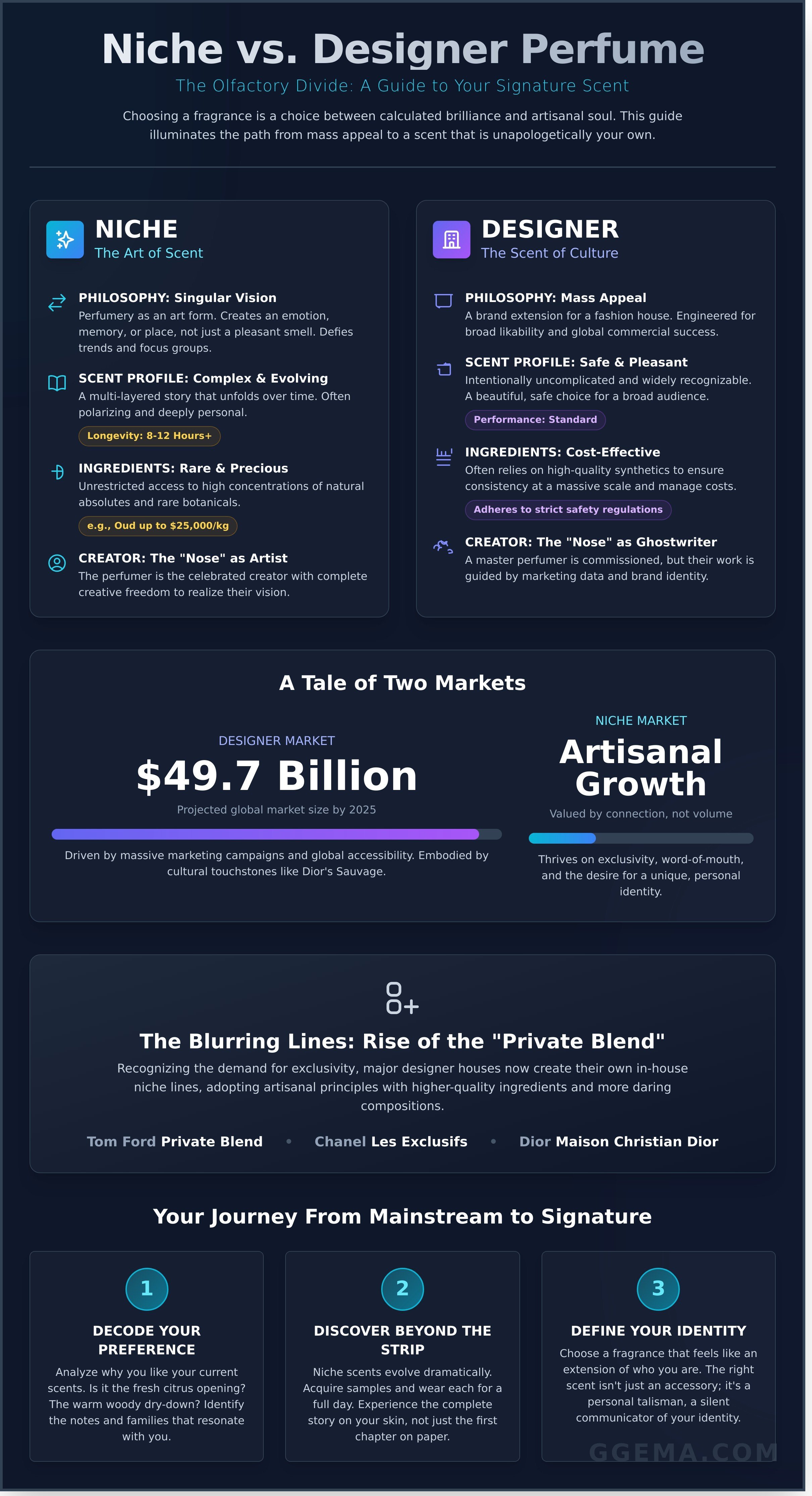
You’ve felt it. That quiet deflation when your chosen fragrance greets you on a stranger, a scent worn by millions by design. A 2025 report from Grand View Research projects the global designer fragrance market will reach $49.7 billion, a testament to its universal appeal. But universality isn’t identity. It’s the opposite. True luxury is personal, a conscious choice that resonates with who you are, not who the world expects you to be.
This is where the conversation of niche vs designer perfume begins. It’s a choice between calculated brilliance and artisanal soul. We’re here to provide a new clarity, a modern framework for discovering a fragrance that feels less like an accessory and more like a talisman. This guide promises to illuminate the path to a signature scent that is unapologetically your own. We will explore the profound differences in craftsmanship, philosophy, and raw materials that define this olfactory evolution.
Key Takeaways
- Decode the core differences in the niche vs designer perfume debate to distinguish between mass appeal and pure artistic vision.
- Understand how creative freedom and rare raw materials empower niche perfumers to craft truly unique and unforgettable scents.
- Learn to assess a fragrance's true value by analyzing its performance and projection, not just its initial price tag.
- Acquire the tools to confidently transition from mainstream brands to finding an artisanal scent that reflects your personal identity.
The Olfactory Divide: Defining Niche vs Designer Perfume
Scent is an architecture. A statement of self, crafted from ephemeral notes. In the world of fragrance, two distinct philosophies compete for this personal space, creating a clear olfactory divide. Understanding the core tenets of each is the first step toward defining your own signature. The conversation of niche vs designer perfume is not about good versus bad; it’s about intent, artistry, and accessibility.
This distinction sharpened in the early 21st century. As designer fragrances saturated the market with celebrity-endorsed, universally appealing scents, a counter-movement gained momentum. Artisans and independent perfumers began creating an alternative to mass perfume production, prioritizing creative freedom over focus groups. Yet today, the lines are blurring. The very success of niche has inspired major houses to adopt its principles, creating a more complex and exciting fragrance landscape.
What is a Designer Perfume?
A designer fragrance is a brand extension. An accessible key to the gilded world of a fashion house like Dior, Gucci, or Prada. Created to capture a massive global audience, these scents are engineered for broad likability. They are the "safe scents"-beautiful, pleasant, and intentionally uncomplicated. Their development, often managed by fragrance giants like L'Oréal or Coty, involves extensive market research to ensure they appeal to millions. This philosophy is powered by staggering marketing budgets, with campaigns featuring A-list actors like Johnny Depp for Dior’s Sauvage solidifying their status as cultural touchstones.
What is a Niche Perfume?
Niche is a rebellion in a bottle. It is perfumery as an art form, where the scent is the masterpiece, not an accessory to a handbag. These are artisanal houses, such as Le Labo or Byredo, built solely on the craft of fragrance. Their purpose is not to smell good in a conventional sense, but to evoke a feeling. A memory. A place. Think of the scent of an old book, a specific coastline, or a forgotten temple. With limited distribution through exclusive boutiques, their allure is magnified by their rarity. They trade mass appeal for a deep, personal connection with the wearer.
The modern evolution in the niche vs designer perfume debate is the rise of the "private blend." Recognizing the discerning consumer's desire for exclusivity, major houses have created their own in-house niche lines. Tom Ford's Private Blend, launched in 2007, was a definitive market signal. It was followed by collections like Chanel’s Les Exclusifs and Dior’s Maison Christian Dior. These fragrances adopt niche principles: they feature higher-quality ingredients, more daring compositions, and are sold at a premium, bridging the gap between two once-separate worlds.
The Creative Blueprint: Why Niche Fragrances Defy the Mainstream
Artistry over algorithms. This is the defining principle that separates niche perfumery from its mainstream counterparts. While designer fragrances are engineered by marketing committees to achieve mass appeal, niche scents are born from a singular vision. They are olfactory narratives, composed without compromise and designed to evoke a specific emotion, memory, or place. The core distinction in the niche vs designer perfume debate isn’t price; it’s philosophy. One creates a product for a market. The other creates art for an individual.
This approach results in a fragrance that is complex, often polarizing, and deeply personal. A niche scent doesn't just smell pleasant. It evolves on the skin over 8 to 12 hours, revealing a multi-layered story with a distinct beginning, middle, and end. It’s a conscious choice to wear something with intention and character.
Quality of Ingredients
The perfumer’s palette is everything. Niche houses grant their creators unrestricted access to the world’s most precious raw materials, from ethically-sourced oud costing upwards of $25,000 per kilogram to iris butter that requires six years to mature. This commitment to quality is palpable. While designer brands often rely on cost-effective synthetics, niche perfumery champions a higher concentration of natural absolutes and rare botanical extracts. This doesn't mean synthetics are avoided; modern perfumery uses both for structure and safety. All formulations must adhere to strict guidelines, and the U.S. Food and Drug Administration offers comprehensive details on how Fragrance ingredients in cosmetics are regulated for consumer transparency. The difference lies in the balance and the intent. The result is superior longevity and sillage, where a single application lasts the entire day.
The Role of "The Nose"
In the world of designer perfume, even the most celebrated perfumers often work as ghostwriters. A master like Alberto Morillas, the nose behind over 400 commercial scents including Acqua di Gio and CK One, creates a brilliant formula that is then tested, tweaked, and ultimately approved by a brand’s marketing team. The final product is a compromise. Niche perfumery, however, champions the "auteur" theory. The perfumer is the artist, their name proudly displayed on the bottle. Their creation is a signed piece of art, an undiluted expression of their creative genius. This is the critical difference in the niche vs designer perfume dynamic: one is design by committee, the other is a singular vision. This philosophy of collaborative artistry is central to our own process. Explore the Ggema Scent Collection to experience a new vision of olfactory design.
Investment vs Access: Performance, Pricing, and Exclusivity
The initial price of a niche fragrance can feel steep. A barrier to entry. This perspective, however, overlooks the core equation of value. True luxury isn’t measured by its upfront cost, but by its lasting impact, its performance, and its personal resonance. It’s an investment in artistry, an asset that becomes part of your identity.
Analyzing the cost-per-wear reveals a different story. The conversation about niche vs designer perfume often stalls at the price tag, ignoring the superior concentration and quality that defines the former. One or two sprays of a potent niche Extrait de Parfum can outperform five sprays of a mass-market Eau de Toilette, making the bottle last significantly longer and delivering a far more profound experience.
The Cost of Artistry
A designer fragrance allocates up to 40% of its final cost to marketing. Celebrity endorsements. Global campaigns. The scent itself is often an afterthought. Niche perfumery inverts this model. The budget champions the formula. This relentless focus on olfactive art is central to defining niche perfumery, where your investment prioritizes rare distillations and master perfumer research over mass-market appeal. Your money buys ingredients, not illusions.
Small-batch production ensures a level of quality control and precision that is impossible at an industrial scale. Hand-finished bottles, artisanal caps, and meticulous packaging transform the object into an heirloom. It’s a tangible connection to the creator's vision. This is craftsmanship you can feel.
A new era of conscious luxury is also dawning. Responding to a growing demand for sustainability, innovative houses like Kilian Paris and Le Labo now offer elegant, refillable flacons. This system can reduce packaging waste by over 60% with each replenishment, creating a fragrance designed for a lifetime, not just a season.
Exclusivity and Identity
To wear a niche scent is to make a silent statement. It’s the difference between a uniform and a bespoke garment. You won’t smell your signature scent on ten other people in the same room. This calculated rarity creates a powerful psychological anchor, linking a unique fragrance directly to your identity and memory.
Scent becomes a radical form of self-expression. A rejection of the focus-grouped fragrances engineered for broad, commercial appeal. Niche offers a personal narrative. It allows for nuance, complexity, and even challenging notes that reflect a more authentic self. It is non-conformity, bottled.
The barrier to entry has been reimagined. The culture of "Discovery Sets" offers a curated, low-risk exploration of a brand's universe. For $30 to $60, you can intimately experience a collection of 5-10 scents, finding a true match before committing to a full bottle. It’s an invitation, not a gate.
This journey of discovery circles back to performance, a key differentiator in the niche vs designer perfume dynamic. Niche fragrances often contain higher concentrations of pure perfume oils, delivering tangible benefits:
- Superior Longevity: Lasting 8-12+ hours on skin, evolving with you throughout the day.
- Elegant Projection: A scent bubble that invites discovery, not a fragrance that shouts for attention.
- Complex Evolution: The scent transforms over hours, revealing new facets as it melds with your unique skin chemistry.
The cost-per-wear plummets. The value becomes undeniable. This isn't just a purchase; it's the beginning of a personal olfactory legacy.
The Signature Hunt: How to Transition from Designer to Niche
The transition is an evolution. A conscious departure from the familiar into a world of pure, olfactory art. Moving from mass-produced scents to artisanal creations isn't about abandoning what you love; it's about elevating it. It’s about finding a fragrance that doesn’t just smell good, but feels like an extension of your own essence. A true signature.
Finding Your Olfactory Vibration
Your energy has a scent. The first step is to identify its family. Most fragrances fall into one of four core families, a classification system first charted by Michael Edwards in 1992. Understanding them brings clarity to your search.
- Floral: From solitary rose notes to complex white bouquets. Romantic, bright, classic.
- Oriental: Rich and opulent. Spices, resins, and sweet vanilla. Warm, sensual, bold.
- Woody: Earthy and grounding. Sandalwood, cedar, vetiver, and smoky oud. Elegant, composed, mysterious.
- Fresh: Clean and vibrant. Citrus, aquatic notes, and green herbs. Energetic, crisp, modern.
If you adore a designer scent like Dior’s J’adore, a radiant floral, your niche journey might lead you to a creation that deepens and refines that floral profile with unique, sophisticated facets. The key is to identify the notes you love and seek their most authentic, masterfully crafted expression. Pay attention to concentration, too. An Eau de Parfum (EDP) contains 15-20% pure perfume oil, offering hours of wear. An Extrait de Parfum, however, is the pinnacle of luxury with 20-40% concentration, a potent elixir that melds with your skin for an entire day.
The Art of Sampling
Never commit on paper. A fragrance blotter tells only the first chapter of a story; your skin writes the rest. The true test in the niche vs designer perfume debate is how a scent’s molecular structure interacts with your unique body chemistry. This is where sampling becomes a non-negotiable ritual. Discovery Sets are the modern answer-a curated library of scents to live in before you invest.
Wear a single fragrance for a full 24 hours. Experience its evolution from the bright top notes that greet you, through the heart notes that define its character, to the deep base notes that linger like a memory. This final stage, the "dry down," is where a niche perfume’s quality truly reveals itself. Note the ingredients that resonate. Do you find yourself drawn to the creamy warmth of Sandalwood? The sharp, clean burst of Bergamot? This data is your map. It refines your search, guiding you with precision toward your perfect match.
This is not just a purchase. It is a discovery. A deliberate and personal process of curation. The reward is a scent that is unequivocally yours. Begin your olfactory evolution with our Discovery Sets.
Ggema Paris: The Next Evolution of the Niche Talisman
The conversation around niche perfume often centers on rare ingredients and artistic freedom. But what comes next? Where does the category evolve beyond scent alone? The answer is Ggema Paris, a house that redefines the very essence of fragrance by transforming it into a personal talisman.
This isn't just perfume. It's an energetic signature.
Ggema moves beyond traditional olfactive pyramids by infusing each creation with the vibrations of genuine, ethically sourced gemstones. The result is a chromatic and sensory journey through four distinct collections: the ethereal glow of Moonstone, the fiery passion of Ruby, the tranquil depth of Sapphire, and the vibrant life-force of Emerald. Each bottle contains not just a fragrance, but a wearable piece of the Earth’s energy, meticulously crafted to align with your own.
Scent Meets Crystal Energy
At Ggema, the fusion of gemology and perfumery is a precise art. Consider the Moonstone collection’s twin elixirs, Selene and Artemis, which capture lunar luminosity through a patented 30-day maceration process with genuine moonstones. Or feel the heat of Ruby - Rouge, a composition that translates the gemstone’s fiery energy into an olfactory flame of saffron, raspberry, and oud. This is where high perfumery becomes alchemy.
This commitment to a deeper, more meaningful experience is what sets the brand apart in the ongoing niche vs designer perfume debate. While designer brands market a lifestyle, Ggema offers an internal state. A resonance. It’s a conscious luxury, where the value lies not only in the exquisite scent but in the intention and ethically sourced materials behind it. The alcohol is derived from organic French wheat. The gemstones are sourced from suppliers compliant with the Kimberley Process Certification Scheme, ensuring they are conflict-free. Every element is chosen with purpose.
This philosophy is why Ggema represents the future of its category. It satisfies the modern desire for authenticity, personalization, and a product that carries a story beyond its label. It’s a multi-sensory experience that connects the wearer to something elemental and profound.
Parisian Heritage, Modern Vision
Born from the legacy of high jewelry at 10 Place Vendôme, Ggema merges Parisian craftsmanship with a bold, forward-thinking vision. This is the definitive choice for the modern non-conformist, the individual who understands that true luxury is personal, ethical, and vibrantly alive. It’s for those who have moved beyond the question of niche vs designer perfume and are now asking what their scent can do for them. Explore the Ggema Discovery Set and find your mineral match.
Craft Your Olfactory Legacy
The debate of niche vs designer perfume ultimately resolves into a choice. A choice between the familiar and the visionary. Designer fragrances offer a gateway. Niche perfumery, however, offers a destination. It’s a commitment to unparalleled artistry, moving beyond the mass-market trends of the last 10 years to find a scent that becomes a true extension of your identity.
This evolution finds its ultimate expression in Ggema Paris. A new era of olfactory art. Born at the epicenter of high jewelry, 10 Place Vendôme, our gemstone-infused compositions are masterpieces. Crafted in collaboration with world-renowned perfumers, each talisman is an object of profound beauty and conscious luxury. More than perfume. A personal emblem.
This is your invitation to transcend the ordinary. Discover the Chromatic Talismans of Ggema Paris. Your signature scent awaits.
Frequently Asked Questions
What is the main difference between niche and designer perfume?
Artistry over mass appeal. The core of the niche vs designer perfume debate is distribution and artistic focus. Niche perfumes are crafted by independent houses focused solely on scent, with distribution limited to boutiques. Designer brands, like Chanel or Dior, are fashion houses where fragrance is one of many product lines, with over 90% of their sales from department stores. A focus on singular expression. A conscious choice.
Why is niche perfume so expensive compared to department store brands?
Craftsmanship commands its price. Niche perfumers use rare, high-concentration natural oils, often costing up to 15 times more than the synthetics common in mass-market fragrances. Production runs are small, sometimes fewer than 10,000 bottles globally, ensuring exclusivity and meticulous quality control. It's the cost of true artistry, not a marketing budget. A scent reimagined.
Does niche perfume last longer than designer perfume?
Longevity is a hallmark of quality. Many niche fragrances are formulated as Eau de Parfum or Extrait de Parfum, with oil concentrations between 15% and 30%. This is significantly higher than the 5-15% found in most designer Eau de Toilettes. The result is a scent that endures, evolving on the skin for 8 hours or more. A lasting brilliance.
Can I wear niche perfume every day, or is it only for special occasions?
Your signature scent is a daily ritual. It isn't reserved for ceremony. The modern luxury of niche fragrance lies in its personal connection, making every day an occasion. With diverse scent profiles from houses like Byredo or Le Labo, you can find an intimate scent for the office and a bolder one for the evening. It's a personal evolution.
What are the best niche perfume brands for beginners in 2026?
A new era of scent discovery. For 2026, start with brands like Jo Malone London for its elegant, layerable colognes or Diptyque for its transportive, nature-inspired creations. For something more modern, consider Phlur, a brand championing transparency since its 2022 relaunch. These houses offer clarity and sophistication, a perfect introduction to the world of artisanal perfumery.
How do I know if a perfume is niche or designer?
The distinction lies in its focus. If a brand's primary creation is fragrance, it's likely niche. Think Creed, founded in 1760, which has focused solely on scent for centuries. If the brand is a global fashion or jewelry house like Gucci or Tiffany & Co., its fragrances are designer. The debate of niche vs designer perfume often comes down to this singular purpose.
Is it worth buying a niche perfume discovery set?
Yes, a discovery set is an intelligent and cost-effective way to explore niche perfumery. A set, typically costing between $30 and $60, allows you to experience 5-10 different scents on your skin before committing to a full bottle, which can exceed $300. It's a curated journey, an investment in finding a scent that truly reflects your own brilliance. An exploration without compromise.
What does gemstone-infused perfume mean?
It is a fusion of energy and aroma. This practice, popularized by wellness-focused houses since 2020, means small, polished crystals are placed inside the fragrance bottle. A piece of rose quartz for love or amethyst for clarity. It's rooted in the belief that gemstones impart their energetic properties into the liquid, transforming the fragrance into a talisman. A conscious ritual of scent and spirit.


